St Agatha’s Church Rebuilt
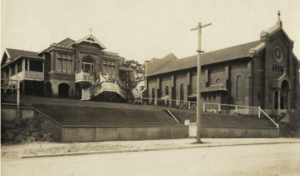
In March 1921 Father Frances O’Connell arrived in Clayfield. He was the first Parish Priest of the newly formed parish, which until that time had been part of the parish of Wooloowin. His early work in the parish convinced him that the parishioners had serious need of a school of their own. He approached the problem by undertaking the construction of a new church and converting the old wooden church to a school. The old church at Clayfield had only been built in 1918, being completed by the end of September that year. It was a wooden structure halfway up the hill towards the site of the present St Rita’s.
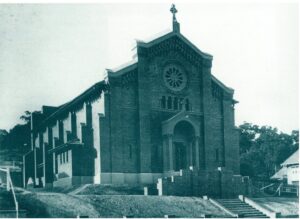
Father O’Connell began an ambitious project – the second St Agatha’s, a large brick church to cost £10,000, and overlooking from its raised position the quiet avenue of Oriel Road. Behind it the steep hillside crowned with the stately mansion of ‘Stanley Hall’ towered. Half way up perched the old St Agatha’s, built in wood and now destined to serve as a school. The church property, hilly, steep and as yet only partially cleared, extended around this building.
The Presentation Sisters had been approached as early as 1915 by Archbishop Duhig to open a school for boys and girls in Clayfield. In 1925 the new St Agatha’s church was completed and the Sisters were persuaded by Fr Frank and the Archbishop to come to Clayfield to start the school. The first Sisters to arrive were Mother Mary Patrick Madden, Sister Mary Ignatius Kelly and Sister Mary Bernadette Harman. Initially the community of sisters occupied the presbytery while Fr O’Connell lived in a rented house, and this remained the case until the sisters acquired “Stanley Hall” in September 1926. St Agatha’s school was opened on 27th January 1925 and 120 pupils turned up. By 1926, attendance had reached 230.
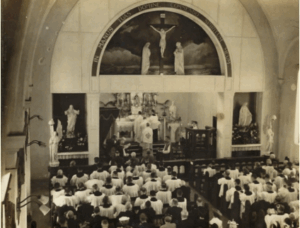
On 5 April 1925 the new brick St Agatha’s Church was opened and blessed by His Grace Archbishop Duhig. St Agatha’s was large enough to accommodate 500 people. The early development of St Rita’s and St Columban’s was also entwined with its parish priest for Fr Frank assisted and encouraged in both these projects, but their stories are beyond the scope of this article. Fr Frank died in the year of his silver jubilee, on 28th December 1939 at age 49, in part attributable to his heavy smoking.